San Jose · FBI Background Check
A job offer overseas or a residency application asks for an FBI background check — and, almost always, an authentication to go with it. Countries use the report as proof of good conduct, and they need it authenticated before it counts. Here is how San Jose applicants get both pieces handled as one process instead of two.

The short answer
Many countries require an FBI background check for a work permit, long-stay visa, or residency application, and they want it apostilled so a foreign authority can trust the document. We capture your prints in San Jose, submit through an approved channeler so the report returns in days, and it can then go straight to the apostille step.
Two pieces, one destination
A report going overseas has to clear two hurdles, and both matter:
The summary
Proof of good conduct, drawn from your prints and returned through an approved channeler.
The certification
The authentication that lets a foreign authority accept a US document as genuine.
It starts with the FBI report, then moves to authentication.
How it comes together
Check the country’s rule
The destination sets the requirement, including how recent the summary must be.
Capture and submit
We take your prints and send them through an approved channeler, so the summary returns in days.
Add the apostille
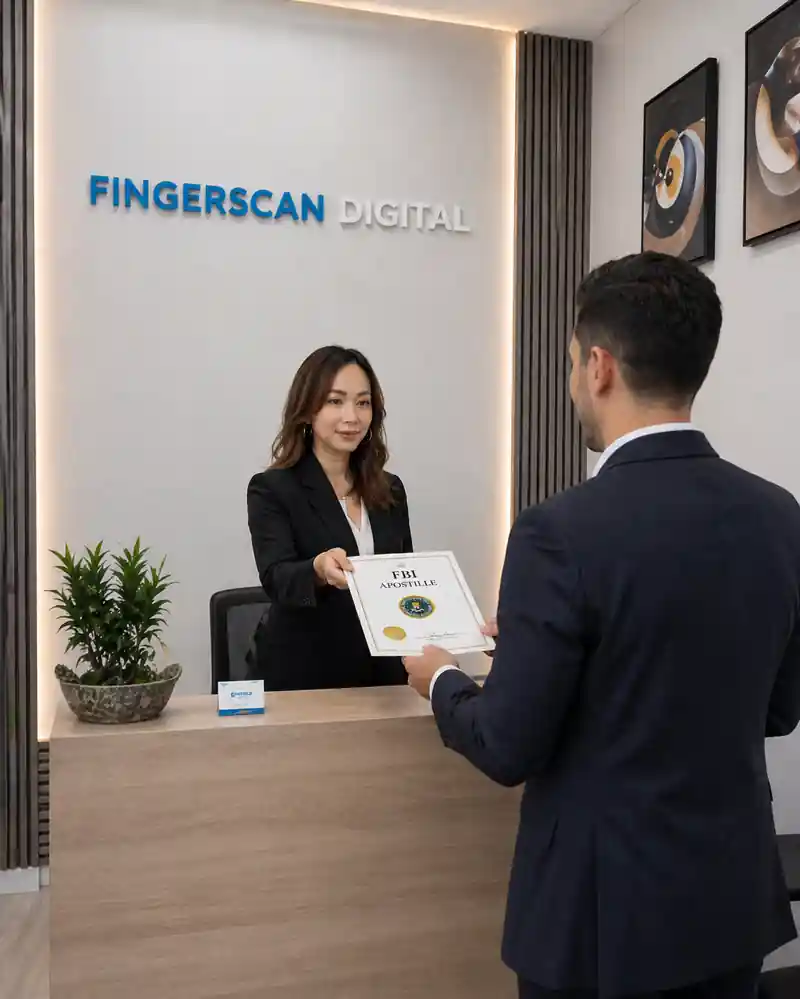
The issued summary then moves to the FBI apostille so it is accepted abroad.
Making a move abroad go smoothly
The slow way to do this is in disconnected pieces: obtain the summary, discover later that an apostille is required, then start a separate errand to authenticate it while a visa deadline approaches. The smoother way treats the summary and its authentication as a single sequence from the start. Because an electronic submission through an approved channeler returns in days, and the authentication follows the issued summary, the whole thing fits inside a predictable window rather than a scramble at the end. Confirm the destination’s recency rule, capture the prints, and let the authentication follow — and the background check becomes one of the easier boxes to tick on a move overseas rather than the one that holds everything up.
Why so many countries ask for it
The pattern makes sense once you see what a receiving country is trying to confirm. When someone arrives to work or settle, the government there has no direct window into that person’s history in the United States, so it asks for a recognized federal record instead. Pairing it with authentication closes the loop: the record shows the history, and the certification shows the record is real. That is why work permits and residency applications so often list the same two items together. The exact rule belongs to the destination, but the underlying logic is consistent enough that applicants moving to a new country can usually expect some version of this request.
FBI check for going abroad: quick answers
Do I need one to move abroad?
Many countries require it for work or residency, usually with an apostille attached.
Why an apostille too?
It is how a foreign authority confirms a US document is genuine.
How recent must it be?
Often within a set number of months — foreign authorities tend to be strict.
How do I get both done?
We capture and submit the prints; the report returns in days and moves to apostille.
Which countries ask?
Many, for work and residency visas — the destination country sets the rule.
Moving abroad? Get the report and apostille together.
FBI background checks for overseas work and residency in San Jose — captured, returned in days through an approved channeler, and routed to apostille for acceptance abroad. Walk in or book ahead.